Wednesday, February 2, 2022

Bitcoin

This bear market will give me a chance to buy BTC.

What is Bitcoin?

Bitcoin is a trustless and distributed database/network running a shared ledger.  If that means nothing to you, the best explanation is:

If you buy bitcoin you need to watch the 30 minute video to understand it is.  Even if your'e just trading, you have to know what it is so you can risk manage and position size it (can it go to zero?).  Its also the foundation for understanding other cryptocurrencies.  Chapter One of Crypto for Dummies.

Key points derived from the above:

  • Bitcoins are just the unit of currency on a shared ledger.  There's a maximum of 21 million of them.
  • No one controls the bitcoin network.  All miners together agree on changes to the ledger by following the protocol.  This is the mind blowing thing about it - its a ledger/currency with no centralised exchange or backing.  The closest thing in the real world is gold.
  • The only way to control is to gain control over more than 50% of the mining power.  Then the next valid block is whatever you say it is.
  • No one can just change the ledger (or the code implementing it).  If you did this, you are creating a new, separate network.  You could call it "Bitcoin2" but its not worth anything, unless the rest of the world agrees with you and joins your network (starts mining on it).
  • Bitcoin transactions are slow by design.  By itself, bitcoin is not suitable to use as everyday money.
  • Holding a bitcoin just means it is assigned to an address (public key - just a long string of digits) to which you - and only you - have the private key (another string of digits, specific to that public key).  If someone else gets the private key, they can transfer the bitcoin.  If you lose the private key, you lose (access to) the bitcoin forever.
  • All bitcoin transactions are stored on the blockchain forever.  Someone with enough resources and motivation (like the FBI or IRS) could trace the trail of addresses back to the money initially used to buy it.  I wouldn't use bitcoin at a strip club, for example.


Bitcoin Trends

Increasing Adoption

As bitcoin is more widely adopted as a store of wealth, it becomes more valuable, so more likely to be adopted.  A  bit like gold, which is valuable because its rare, fungible, (a bit) divisible, and because everyone else values it.  As bitcoin was the first electronic and trustless store of value, it has a first mover advantage and a network effect.

If the lightning network gains enough users, bitcoin may end up being used as everyday money.

Cyclical Trends

Bitcoin is 'digital gold' but it doesn't trade like it.  It trades as a risk on commodity.

Before 2020, it was uncorrelated with the S&P 500, after that it correlated weakly:

I'm waiting for the end of this correction to buy it.

Threats

Regulatory Threats

Bitcoin is not under threat from the SEC, it is not a security.  It never underwent an ICO.  The anonymous founder of bitcoin, Satoshi Nakamoto, mined his coins it along with everyone else after introducing it in 2009.  He never issued bitcoins to "investors".

The IRS is asking about cryptocurrencies 2021's tax return.  While this makes it harder to use bitcoin as money (having to calculate capital gains tax every time you 'sell' to BTC to buy something), it means the government is unlikely to ban it.

Decentralisation

The bitcoin network is highly decentralised.  No one controls it, and even the US government could not shut it down if they wanted to.  The best they could do is to limit people from buying it on (most) exchanges.

China used to have a 75% share of (power used in) bitcoin mining, potentially giving the CCP control of the network.  After their crackdown on bitcoin mining last year, they now have less than half.  This was the biggest threat to the bitcoin network.

Technical Issues

The protocol is simple and has been tested for years, with no bugs or exploits.

Quantum computing will be a threat later, allowing a private key to be derived from its public key.  I think there are quantum resistant algorithms that the bitcoin network can fork to.  But I'm not sure (quantum-proof, or quantum resistant?).

ESG

This is the biggest long term threat.  Bitcoin scores poorly on ESG criteria, because of its power usage.  Other cryptocurrencies that don't use Proof-of-work may be more widely accepted.

USDT and Leverage

This is the biggest short term risk.

Tether (USDT) is a stablecoin commonly used to buy bitcoin.  Its issued by a Hong Kong company, who says the USDTs they issue are backed by real-world USDs.  This has never been proven.  A collapse in USDT would hit bitcoin (and all cryptocurrencies) hard.

My gut feeling is it will happen sometime.  Any bubble - any asset rising 100 times in under 10 years - is going to attract both leverage and crooks.

Conclusion

I think the bitcoin network is stable, tested, growing and legal enough that it will still be around in ten years.

Crypto is the ultimate "risk-on" asset.  Bitcoin has fallen around 50% since its highs early last year.  I plan to buy some when the correction ends, or is over, using Hedgeye for market timing.  Its so volatile, and the risks are so great (Tether), I don't want to hold it through a down market.

Or wait for Tether to crash/de-lever the whole crypto market so badly that no one wants to buy.  Then nibble at it.

Monday, January 31, 2022

Ascendas India Trust Update

AIT released disappointing 2021 results, and the stock price dived 9%.  A quick update.

Drop in Income

AIT's 2021 "Income available for distribution" was down 11%, or SGD 12.6m.  

The culprit was Income tax expenses, up SGD 50m, "mainly due to higher deferred tax liabilities arising from acquisition of aVance 6 and annual revaluation; together with lower current income tax resulting from reversal of dividend distribution tax (“DDT”) provision in FY 2020."  In English, 2020's income was artificially inflated by the reversal of a dividend distribution tax provision; now 2021's income is back to normal.  But I don't know how much of the 50m this contributes to, and how much of the remainder is a one-off.

Other than that, their numbers look OK.  98% of rent was collected, though only 11% of the properties were populated.  Rental reversions were 5.5%.

Risks

Longer term, the risks I see are:

Cyclical Property Downturn

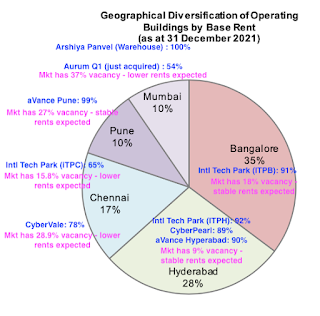
Here are their properties/areas.  The blue numbers are occupancy rates.  The pink text gives the vacancy rates in each property's micro-market:


Source: 2021 Results, pages 5, 32-33. 

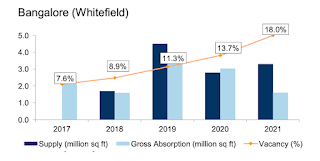
1/3rd of their rent is from ITPB.  This micromarket is under some pressure due to un-absorbed supply added in 2021:


Their Chennai, Pune and Mumbai micro-markets also have high vacancy rates, from the teens to the 30's!  A bit worrying.

Fortunately, they don't have many lease expiries in these oversupplied areas (red, below).  Most upcoming expiries are in the strong hyperabad market (blue):

They've probably planned this, so hopefully they can make it through the downturn without much DPU loss.

Work From Home

This has been in the back of my head bugging me.  Technology or Business parks are just cheap offices with server and equipment rooms attached.  Most workers want to work from home at least a few days a week.  Most IT work can be done remotely.  And most Indian IT professionals are paid enough to hire help to look after the children.  Even working from home one day a week will cut office space demand at the margins, leading to rental drops for the fixed office supply.  We may see this over the next few years of lease renewals.

Growth

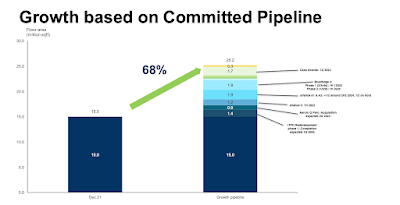
Their pipeline looks good:

Leverage and Capital Structure

Will they have to raise capital?

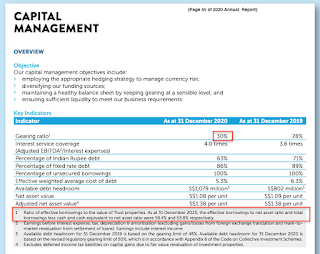
They say they only have a gearing ratio of 35%, and debt headroom of nearly SGD 1bn.  I could not calculate 35%, either from their Supplementary Info or Balance Sheet.  I get 40-45%.  I also see different numbers in their 2020 Annual Report.  So I don't know how they calculate their leverage:

Anyway, MAS' 50% leverage limit does not apply to Business Trusts, so its voluntary for AIT.  Their leverage ratio can be whatever they say it is.

Everything depends on their debt headroom.  In 2021, interest and dividends paid equalled CFO.  But CFI outflows were more than CFO, resulting in a large debt increase.

AIT has only raised capital once after their IPO: a small SGD 150m private placement in November 2019.  It was mildly pro-forma DPU accretive (p4).

Conclusion

I like AIT's long term track record of growing DPU.  They have good tenants, long property tenure (or freehold), and an expansion plan in progress.  I expect short term hiccups from the exchange rate and the property cycle as part of doing business.

They will probably have to raise equity soon,  as interest plus dividends paid now equals CFO.  Thats OK, as long as its not dilutive.

I'll keep holding it.

Wednesday, January 26, 2022

Quick Update: Sold all my CNQ, bought more gold

Sold the last of my CNQ tonight.  I think the correction continues and drags oil down.  I hope to buy it back after the correction.

Bought 0.5% more gold tonight, continuing to accumulate.  Now have 5.5%.  Want to get up to 10%.   I hope to sell it during the correction to buy stocks.

I'm now 101% invested.  95% excluding gold (as a type of cash).


Update 27/Jan: Gold down a big 2.5% last night on Powell's insistence that he will raise rates.  Just bought another 2.5%, now holding 7.5%.

Update 28/Jan: Gold down a bit more, bought another 2.5%, reached 10% allocation.

Friday, January 14, 2022

Sold 1/3rd of my CNQ position

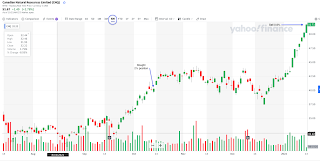
 I bought a 2% position in CNQ 3 months ago, in the last month its up 20%.  Its starting to look parabolic:

I like this company and want to hold it for the next few years.

But I expect a correction around 2Q, which would hit oil.  CNQ is a high beta oil stock.   Short term, its way, way overbought.  And 2Q is only 10 weeks away, while the market is forward looking.

Sold 1/3rd of my position, @ CAD 64.44, profit 1.9K CAD or 29%.  Will sell more if it goes higher and my outlook stays the same.

Hope to buy it back cheaper later.

Monday, January 10, 2022

Quick Updates: Mapletree Commercial Trust and Gold

Mapletree Commercial Trust owns a popular mall and 2 business parks in the southern part of Singapore.  I bought a small 2-3% position during the 2020 crisis, but never had a chance to buy more.  Turns out to be lucky.  They recently announced a disastrous merger to bail out their HK based sibling.  I don't like the new properties injected (office and discretionary retail), and its too small a position to investigate all these properties scattered around Asia.  I sold it today, taking a small 18% profit, excluding dividends.

For me, its changed from a "buy-and-hold-forever" stock to a "buy-if-cheap" stock.  The number of good companies on SGX grows smaller day by day.

Bought a 4.5% position in gold when it was oversold the past few days.  Hoping to get up to 10%.

Sunday, January 9, 2022

Quick Update: Kazakhstan

Riots have erupted in Kazakhstan sparked by rising gas prices, but fanned by inequality and corruption.  This is the risk in investing in poor, one-party states.  The situation may be more stable today after Russian troops restored order.

Kazatomprom stock has fallen around 20%.  I believe the unrest will not directly affect Kazatomprom's output.  I think the Russians will take control, and Kazakhstan will become a Russian satellite again.  Back in the USSR.

Peter Zeihan gives a maps and history of the events, with the above prediction, plus some of its affects on oil/gas markets:


My best guess is that hes right.  It is unfortunate for the Kazakhs, but a poor, empty country of 20m people next to Russia can not be free.

This Al Jazeera interview (starting 11:30), suggests that President Tokayev has taken power from the unpopular Nursultan Nazarbayev, who was retired but still influential behind the scenes.

I've kept my Kazatomprom stock, too late to sell now, the bad news is priced in.  Not buying more as I'm already at my max position size.

Sunday, January 2, 2022

Total Energies

Though I've avoided the oil majors so far, Total Energies looks like the best of them.

Business

Excluding 2020, half to 2/3rds of their profits come from oil and gas production:

E&P includes gas production.  The "Gas" in "Gas, Renewables and Power" is midstream/upstream.

As I'm expecting higher oil prices, I want companies with high exposure to oil and gas production.  50-66% is a bit on the low side, but still OK

Reserves

I want to see reserves not depleting over time.  I also split reserves between oil and gas because oil is worth more (in BOEs):

Source: Total Energies' Universal Registration Documents. Search for "Proved Reserves for"

Looks good.

Geopolitical Risk

Their reserves and production are spread around the world:


Source: 2020 Universal Registration Document p68

30% of their gas in from Russia - there's a risk the Russians kick them out (for whatever reason), or they are forced to stop trading with them from US pressure if Russia invades Ukraine.  Even if France did not obey, Total would lose access to swift, and I don't think thats an option today.

Not much dependence on the Persian Gulf, which is always a potential warzone.

ESG Risk

This is the biggest long-term risk to the Oil Majors, and the hardest to predict.  I liked XOM and Chevron before minority shareholder activists Engine 1 added 3 members to XOM's board (1) (2).  Unfortunately the French Government no longer has a stake or golden share in Total, so I don't know if the same thing could happen to them.  I think the French Government have a lot more control over their corporates than the US does - more like Singapore or Norway.

Although Total has been investing more into renewable energy, 75% of their capex will still go to hydrocarbons with natural gas slowly replacing oil.  By 2030, they aim for a sales mix of 30% oil, 50% gas, 15% electricity and 5% biomass and hydrogen, with petroleum product sales decreasing by at least 30% over the period 2020-30.  

Their numbers seem realistic.  I like that they talk straight and are not pretending to be a non-petroleum company.

Valuation

At a share price of Euro 45, based on their annualised 9M21 results, its going for 9.4X earnings.  Valuations don't tell us much since they all depends on the oil price anyway.

The dividend yield is 5.8%, which is covered by their 1Q, 2Q and 3Q earnings (payout ratios of 60%, 94% and 41% respectively).  The dividend was maintained throughout 2020 (which I am not so keen on - I do not feel comfortable with a loss-making company paying dividends while pretending to be a bond).  They have no plans to raise dividends.

French witholding tax on dividends is 28% from 2020 onwards.  Singapore residents should pay only 15% (p13), but it depends on your broker and is probably too costly and time consuming.

Conclusion

This company is OK.  Its hard to find good oil producing companies, so I'll keep it on my watchlist.  The witholding tax is a killer.