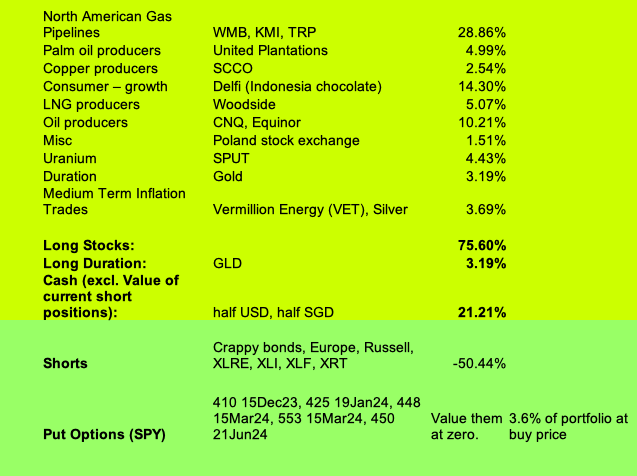
Thursday, November 30, 2023

Equinor Update

Update and Review of Equinor.  I may buy some more energy producers in a few months if we get a downturn.  Here I look at their latest numbers and their ESG plans.

Segments

Equinor is primarily an Norwegian energy play, with 90% of 2022 Net Operating Income from E&P, and three quarters of that from Norway.  

How much is oil vs gas?  In dollar terms, usually more oil, but it varies with prices.  In the first 9 of months 2023, they sold more oil than gas, but in the same period of the previous year, more gas than oil (page 29).  Due to the massive spike in European gas prices in 3Q2022:

Cashflows

They've been printing money in the past 2 years due to high oil/gas prices.  2022 was a bumper year, 2021 more normal:


Quarterly cash-inflows vs cash-outflows:

Notes:

  • Quarterly CFO does not correlate with oil/gas prices, because taxes (payable) seem to be accumulated in Q1 and paid out in other quarters.
  • Since quarterly data is noisy, calculate the payout ratio (CFO divided by dividends plus buybacks) for each calendar year: in 2021 it was 35%, 2022 was 48%, YTD 2023 is 94%.  In 2022, they spend almost all their generated cash on dividends/buybacks.

Balance Sheet and Capital Allocation

They've paid off their debt in 2021, accumulated cash in 2022, and have been returning capital in 2023:

But not all their cash and financial investments can be counted:
  • Their 28bn financial investments "mainly relate to investment portfolios held by Equinor’s captive insurance company and other listed and non-listed equities held for longterm strategic purposes" (p177).  We don't know how much is required for insurance.  2020's annual report says the same thing for 12bn of financial investments.  I'll take a wild guess that 12bn is required for insurance, leaving 16bn as long term investments.
  • For their 15bn cash, 6bn is required for hedging (p179).  Lets deduct another 2bn in case oil volatility increases. Leaving us with 8bn excess cash.
  • With debt of 25bn, net debt would be ~ 1bn.
Long term liabilities are 13bn provisions, mostly asset (rig) retirements.  Plus 3bn pensions.

There is no fixed policies for dividends or buybacks - appropriate for a cyclical industry.

The company previously mentioned they would like to return to a 10-15% leverage ratio (p10) - they count all cash and financial investments in this ratio - so that would entail a massive capital distribution.  I'm skeptical about this in today's world: any leverage is too much when you have 5% interest rates and a product whose price can go negative when people catch a cold.

Their main form of capital distribution is dividends.  Not tax efficient, but better than stupid acquisitions.  Overall I think their capital allocation is quite good.

Reserves 


They had 7 years remaining based on 2022 production.  The reserve replacement ratio has averaged 62% in the past 3 years.  Meaning replacement was below production.

Reserves in Norway have remained steady over the past 3 years (p7).

By boe, over half of the reserves are gas:


Business and Political Risks

Very few risks, which makes it a rarity for an energy producer:
  • Norway is a developed, democratic country with rule of law.  Most resource rich countries are shitholes (eg: DRC, Saudi Arabia) or simply poor & corrupt (eg: Indonesia).
  • Seabourne oil can be shipped anywhere.  The production areas and outbound shipping lanes are not in a potential war zone, like the Persian Gulf.
  • Norway's oil tax is 78%, though investments can be deducted over a few years.  This high rate is already priced in, and is actually an advantage, because: 1) Its safe and predictable, they have not changed it eg: like the UK did, and 2) the government is already getting 78% of profits, they're unlikely to take shares away from minority shareholders.
  • Norway is an net energy exporter, so they are unlikely to put a windfall tax on energy producers or restrict energy exports.
  • Offshore oil has low decline rates, unlike American shale.
  • Norway's oil is less carbon intensive to produce compared to Canadian oil sands.

Valuation

Getting a reasonable valuation for energy companies is hard because energy prices have been so volatile.  Lets base it on 2021 and 9M2023 results.  2022 was too much of an exceptional year.


"Cash generated" is CFO minus "capex and investments".

Based on the current stock price of USD 32, the PE would be 8 or 12.  Reasonable, but not dirt cheap,

ESG Risk 

Equinor has an Energy Transition Plan, which I think is the biggest risk to its business:


The first item (reducing carbon use when producing oil) and third item (CO2 storage) are OK.  The second one (spending lots of money on renewable production) worries me:

  • Equinor aims to direct "30 of gross capex to renewables and low carbon solutions by 2025" and " more than 50% of our annual gross investments in 2030 towards renewables and low-carbon solutions" (p21).  It was 14% in 2022 and 11% in 2021:
  • They had to write down their US wind power projects this quarter.  Their UK wind farms are OK because prices are inflation adjusted.
  • In negotiations, they said they "would like to see 4% to 8% real unlevered return from our businesses in -- within renewables" (p12)
Lets do some numbers.  Based on 2021 and 2022 capex:
  • 2021 capex was 8bn, 2022 was 8.7bn.  Of that, 0.9bn and 1.2bn was spent on renewables and low-carbon (11% and 14% respectively).  
  • To bring it up to 30%, we need to spend an additional ~2.3bn by 2025.  To bring it up to 50%, we need to spend an additional 5.3bn by 2030.  They don't need to just bring it up to 50% of current 8bn capex, they need to bring it up to 50% of new ~12bn capex....after they spend more for renewables.
  • These additional sum could make low returns (4-8% real returns) in a much more risky investment.  Essentially we can see FCF (and therefore dividends/buybacks) reduced by this amount.
  • Based on 2021and annualised 9M2022 estimates, the 2030 aim would reduce the cash generated (CFO minus "capex and investments" by 15-17%).  It could wipe out their Net Operating Income (before tax)....though they could now claim back the new investments over several years at a 78% tax rate.

Conclusion

Everything looks good except for the ESG risk.  Time to explore other companies.

Saturday, November 11, 2023

Bought gold and bitcoin

Gold

Been building up my gold (AAAU) position, just reached my max of 10%.  I think the fed has stopped hiking, but I expect inflation to increase from 2+ to 3+ percent, while rates eventually go down (maybe in 2H24).

I'm expecting a decade of inflation.  And gold is also one of the few things that goes up if China invades Taiwan, so useful as a hedge against the unthinkable.

Bitcoin

Hedgeye's Bitcoin trend turned bullish on 23rd Oct, but its been overbought, so hard to accumulate.  Managed to get a 4% position, would go up to 5% (at my buy price).  Thats a very high allocation for such a volatile asset - if it was volatility adjusted vs gold, it would be 1 or 2%.  But I believe bitcoin won't go to zero.

I am a bit uneasy holding a volatile risk-on asset heading into a market correction and recession.  But its been years through the crypto winter and the start of a recovery, so I obey the signal and buy on the trend breakout.  Lets see if Bitcoin stops correlating with the Nasdaq.

Outlook

Still think we're in a bear market heading into a recession.

When would I cover my short positions?  When everyone knows we are in a recession. A Time magazine cover saying “World in Recession” would be useful.  I'd also cover if they drop too much (bear markets don't last forever), or when Hedgeye's trend changes (means I've overstayed my welcome).

2024 is an election year, expect 2H to recover coming out of the recession.  Learn to love inflation.

Energy

Energy recently turned bearish in Hedgeye's trend, so I expect it to get worse and may buy more Equinor and CNQ in a few months.  Not now.

My Positions


Wednesday, October 4, 2023

Sold VET and WHC

Exited these trading positions, because VIX is approaching 20.  The market could start cascading down as VIX approaches the 30s.

For VET:

  • OVX is in the mid 30s.
  • Oil is weakening in Hedgeye's trend signal (but still bullish).
  • VET's chart has a big high-volume-red-candle on Tues night.  Normally one red candle won't make me sell, but combine it with the other stuff.

For WHC, its a harder decision, the chart looks OK - it may keep going up:


I am probably leaving some money on the table here.  A short term trader would probably buy it today and sell a few days later.  Especially as VIX enters the 20s into a choppy market.  But I still decided to sell now since I'm free today, and may not be able to trade later.

Small profit on both trades.

Saturday, September 30, 2023

My Positions

Still think we're in a market correction heading into a recession.

Trades:

  • SPY put options are now mostly in the green, but still have a lot of upside - still holding 'em.
  • Decrease my VET holdings a bit when WTI was overbought and VIX rises into the high teens.  Energy equities can get pounded by the wider market even if energy keeps rising.  I'll keep my lower-beta, cash generating, "blue chip" stocks (Woodside, Equinor, CNQ).  WHC's price action has been strong, so I haven't trimmed it.
  • Use the last-2-day rally for the month-end-markup to add more shorts: Regional Banks (KRE), Poland (EPOL), Airlines (JETS) and Tech (XLK)
Investments:
  • Uranium's (SPUT's) price rise has increased it to 5% of my portfolio.
  • Longer term, its time to start writing a shopping list.  I think it'll be a shallow recession like 2001, not a crisis like 2008.  2024 is an election year, expect the government to drop rates and pump like crazy once the recession starts.
  • But there's no rush to buy.  I can get 4.8% on USD in Interactive brokers and 5.2% in Tbills.  "There is an alternative".

Wednesday, September 6, 2023

My Positions

For investments:

  • Increased TRP to my max of 5%.
For trades:
  • Sold off a lot of gold last week.  Expect higher inflation this month, real rates fall, gold rises.  May get a chance to buy it back cheaper.
  • Copper is not bearish anymore.  Cover my small COPX position.  Was a mistake to hold so long (often against the trend) from middle of last year.
  • Silver bullish again, bought a 0.5% position, may go to 1%.  
Update: 18/Sep/23:
  • Cut Silver, it broke down
  • Took a 1.5% position in WHC, Aussie coal.  Expect price spikes if this winter is cold.  Would go up to 3%.

Update: 27/Sep/23: In the last 2 weeks I:
  • Cut XLF.
  • Took another 1.5% position in WHC.

Update: 28/Sep/23:
  • Take profit on some VET, sell 1%.  Bring down my trading pisition adn VIX nears the 20s.

Sunday, August 27, 2023

Notes on TC Energy (TRP:TSX)

I love gas pipelines, like Buffet's toll roads.  This company owns pipeline throughout North America.  The stock has fallen due to crappy management, and is below its 2020 price.  Its got world class assets, and I don't think bad management can destroy it no matter how hard they try.  Lets take a look.

Segmental Breakdown and Pipeline Details

From their 2022 AR.  "EBIDTA" below means "2022 Comparable EBIDTA".

The business is transporting gas over a continent, so we gotta look at a map to understand it:


US Gas Pipelines (41% EBIDTA):
  • Columbia Gas (6): Transports gas from the Marcellus to markets and pipeline interconnects throughout the U.S. Northeast, Midwest and Atlantic regions.
  • ANR (7): Transports natural gas from various supply basins to markets throughout the U.S. Midwest and U.S. Gulf Coast.

Canadian Gas Pipelines (28% EBIDTA):

  • NGTL (1): gathering and processing from producers in the WSCB to the Canadian Mainline.
  • MainLine (2): Transports gas produced in East Canada to West Canada.  
  • Costal GasLink (26): Pipeline under construction to ship gas from WCSB to the west coast for LNG export.  Its construction has had bad cost overruns, but is now 91% complete.  Expects to be operational 4Q23.
Mexico Gas Pipelines (8% EBIDTA).

Liquids Pipelinse (14% EBIDTA):
  • Keystone (not shown above, see p62).  Transports crude oil from Canada to and through the US for refining, down through Oklahoma to the GOM.  Canada cannot refine most of its crude, which is exported by pipeline to the US (87% of total crude in 2020), and Keystone transports around 14% of that.  There were (costly) expansion plans (Keystone XL) approved by Trump which were cancelled by Biden.

Nature of Revenue and Pricing

Nearly 80% of their EBIDTA is regulated (p28):
  • Meaning that rates negotiated with customers have to be approved by government agencies (FERC - US, CER - Canada) to prevent price gouging. 
  • The Canadian Mainline (7% of EBIDTA) was built before US shale gas was discovered, and has since struggled to compete with cheap US gas coming from the Appalachian Basin (Marcellus).  It has no pricing power.  In this case prices drop - regulation doesn't matter.
So regulation does limit upside a bit, while not protecting downside.

I think the 2020's will be the decade of inflation.  Are TRP's revenues protected against this?

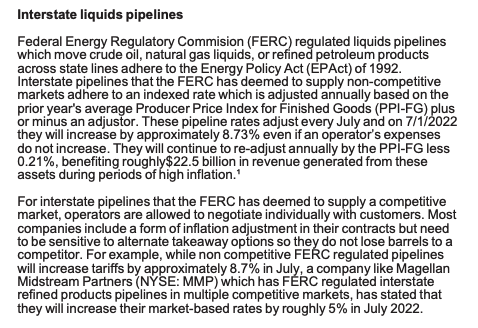
Some FERC rates are automatically-inflation adjusted.  Depending on the pipeline classification, rates are automatically adjusted every year, or inflation adjustments are written into the contract with the customer:


I could not google any information on wether the Canada Energy Regulator adjusts rates for inflation.  The company says NGTL "operates under the terms of the 2020-2024 Revenue Requirement Settlement which includes an ROE of 10.1 per cent on 40 per cent deemed common equity." (p178)  To me, this does not sound like it adjusts for inflation.

Here are some hints that it does take inflation into account:


Source: finchat.io

I could not get any details.  Not sure if they will adjust the entire tariff by the inflation rate, or only the part reflecting increasing maintenance costs (while excluding build costs from the past).  This would be a small adjustment as maintainence costs are low for gas pipelines.

So for inflation protection:
  • US pipelines adjust for inflation.  Yearly if its a "non-compeditive" pipeline.  For "compeditive" pipelines, its based on the contract, so will depend on if you have pricing power.
  • Not sure if/how Canadian pipeline tariffs adjust for inflation (?)
  • If an area has too many pipelines and not enough demand, prices will go down, regulation and inflation adjustments don't matter.

Cashflows

Dividends are lower than CFO, but CFI is very high due to capex on new projects.  CFI plus dividends has exceeded CFO in many years:


Projected capex is below.  Maintenance capex (part of CFI) is approximately ~2bn per year.  I've annotated for their later Costal GasLink blowout:


So its not until 2026 that they'll start paying down debt.

Debt

At end 2022, debt was 51bn: 41bn in loans or notes, plus 10bn in  Junior Subordinated Debt.  Thats unsustainable, at 8X 2022 CFO, or 12X 2022 FCF.  CFO should grow (probably another 3bn in the next 5 years) as the new projects come online, so that makes it a bit better.

Debt maturity (I have not broken it down into USD/CAD debt):


What is the effect of rising rates on their debt?  I went through years of annual reports - they did not make it easy - to consolidate their debt issuance.  They have:
  • 30bn fixed rate debt
  • 8bn floating rate
  • 3bn unknown
  • 10bn Junior Subordinated debt. (p195).  These are fixed rate for the first ten years,before converting to floating rate.
If all debt due by end-2027 is refinanced at 9% (The 20 year risk free Canadian rate is ~3.7%, the US one is 4.5%.  I'm using a high rate for high debt and shitty management)...then their 2022 results would have ben lower by 900m, a 20% reduction in FCF.  The same stress test for WMB and KMI give 10% and 7% reductions respectively.

The key thing for this company is no more cost blowouts till 2025, then being able to pay down debt after that.

Risks

  • Canada's carbon tax is $20/ton today, but due to increase to $170 by 2030.
  • The company has a history of operational problems: Milepost 14, Keystone pipeline leaks, Columbia gas line pressure drop. Concerned it may be a cultural issue.
  • To much debt, especially when the Junior Subordinated debt converts.
  • They may move into ESG and renewables, which have lower returns.

Valuation

At CAD 48, its trading at a 7.75% yield.  Thats paying out 75% of their 2022 FCF.

New projects coming online should increase CFO by half in 3-5 years, but they need to pay down debt.

Misc

I don't know the withholding tax rate.  Interactive Brokers usually charges me 15% for Canadian stocks, but TRP has significant operations in the US, so it may be higher.

Edit: Nov 2023: Confirmed my witholding tax is 15%

The stock plunged three weeks ago on news of the Keystone spinoff, then recovered.  It looks like capitulation, so that may be the turning point.

I have bought a 2.5% position, and would go up to 5%.  My max size for this is half that of WMB or KMI, who have less operational and financial risk.

References

Wednesday, August 9, 2023

My Positions

 Haven't changed much.

  • Rising oil has pushed the portfolio value up a few percent in the past week.
  • 2 nights ago, added shorts for XLI, XLRE and XRT.  Added -7% to my short positions.  Now at max, cannot add more to these positions.
  • Also bought more SPY puts, this is the last time I buy them.
I think this is the turning point, and the market corrects in August.

I am looking to:

  • Remove my 1.5% SLV position, as silver isn't performing.


Edit: 15-aug: Sold silver at a loss, moving on.