Showing posts with label Pipelines. Show all posts

Friday, June 28, 2024

Review of Williams Companies (WMB)

Williams Companies (WMB) has doubled since I bought it in mid-2020.  Should I sell it?

Business Segments

What do they do again?  And how are they affected by energy prices and inflation?

Based on 1Q24 EBIDTA (slide 8):

  • 39%: Interstate Gas Pipelines.  Mostly Transco (30%) running through the east coast, bringing gas from the Appalachians and GoM to consumers and LNG export terminals.  Smaller pipelines in the Northwest.


Regulated long-term contracts: "The rates are established primarily through the FERC’s ratemaking process, but we also may negotiate rates with our customers pursuant to the terms of our tariffs and FERC policy."   In general, FERC gas-transmission rates are often adjusted for cost-of-service (bottom p1), so its like a "delayed" inflation adjustment.
  • 38% Gathering and Processing from gas fields.  Collecting and treating gas (eg: removing NGLs) from producing fields so it can be transported in pipelines.  Mostly volume based.  So indirectly affected by price (eg: revenue drops during warm winters).  Management mentioned these contracts are often inflation protected (bottom p19).  A few of them have exposure to gas prices (bottom p18).
  • 13% Gathering and Processing from oil fields: onshore (7%) and GoM (5%)
  • 4% Marketing.  Deliver gas to customers, bear the risk of price movements in-between the time of order and delivery.  Very volatile.  Was 10% of EBIDTA in 2023, -ve in 2022, and negligible in 2021.
A 2022 Fitch Report estimated that 50% of revenue was from regulated or take-or-pay contracts.  so rough guess: maybe a quarter of their G&P revenue is covered by take-or-pay. 

Cashflows

CFO covers dividends.  But not always CFI and dividends together.  ie: They are investing for expansion:

They rarely sell assets, last made substantial disposals in 2018: 


Maintenance capex was 820m in 2023, and is guided at 800m and 1.2b for 2024 and 2025 (p11).

Growth

Growth capex was 1.9bn in 2023, and is expected to be 1.6bn in 2024 and 1.8bn in 2025 (p11).

The above "growth capex" excludes acquisitions of new businesses.  Following this, I'll take the words "capex" or "growth capex" in this post to exclude acquisitions, which is pretty strange.

Lets put it in a table.  AFFO below is CFO (excluding some working capital changes and minus a few things) - think of it as "Smoothed CFO" 1:

AFFO easily covers maintenance capex plus growth capex, and almost covers dividends after that too.  It doesn't cover acquisitions in 2024, so debt will go up.

They say they've gotten 19.5% ROIC on their 2019-2022 investments (p12).  Seems ridiculously high, but these are usually small "bolt on" projects.  e.g.: small pipelines adding off their main lines, adding new takeaway or feeds to new customers.  Or adding incremental G&P capacity to their existing network.

And thats probably only for growth capex, as recent acquisitions were bought at 7-10X EBITDA (1), (2).

Overall they aim to grow EBIDTA and dividends by 5-7% in the next 2 years.

The background is growth opportunities from the expected US LNG export boom (slide 16):


Management comments on the urgency of this (p17): "Our issue is that our customers, which are some of our best and biggest customers on Transco are –their demands are very urgent. And for us to sit around and wait to finalize any more of the demand that was pending out there, really, it doesn't serve those customers very well." 

To summarise, they are still growing, and taking on debt to afford to both pay dividends and make acquisitions.  At some stage of the cycle - years later - that may become a bad thing, but its good today.

Valuation

Taking FCF to be "AFFO minus maintenance capex" 2, it is projected to average 4.2bn over 2023 to 2025. At a share price of $42.5, thats a price to FCF of 12.x.  Fairly priced for a long term growth rate of 5-7%.

The yield is 4.5% before tax (or 3.1% after tax for me).   AFFO payout ratio is just under half.

Conclusion

Its not cheap anymore - growth is priced in.  I wouldn't buy now, but its not clearly overvalued so I'll hold.  We're probably still at the beginning of the US natural gas export boom.


AFFO is defined by them as "cash flow from operations excluding the effect of changes in working capital and certain other changes in noncurrent assets and liabilities, reduced by preferred dividends and net distributions to noncontrolling interests. AFFO may be adjusted to exclude certain items that we characterize as unrepresentative of our ongoing operations".

Their definition is different - slide 34

Sunday, August 27, 2023

Notes on TC Energy (TRP:TSX)

I love gas pipelines, like Buffet's toll roads.  This company owns pipeline throughout North America.  The stock has fallen due to crappy management, and is below its 2020 price.  Its got world class assets, and I don't think bad management can destroy it no matter how hard they try.  Lets take a look.

Segmental Breakdown and Pipeline Details

From their 2022 AR.  "EBIDTA" below means "2022 Comparable EBIDTA".

The business is transporting gas over a continent, so we gotta look at a map to understand it:


US Gas Pipelines (41% EBIDTA):
  • Columbia Gas (6): Transports gas from the Marcellus to markets and pipeline interconnects throughout the U.S. Northeast, Midwest and Atlantic regions.
  • ANR (7): Transports natural gas from various supply basins to markets throughout the U.S. Midwest and U.S. Gulf Coast.

Canadian Gas Pipelines (28% EBIDTA):

  • NGTL (1): gathering and processing from producers in the WSCB to the Canadian Mainline.
  • MainLine (2): Transports gas produced in East Canada to West Canada.  
  • Costal GasLink (26): Pipeline under construction to ship gas from WCSB to the west coast for LNG export.  Its construction has had bad cost overruns, but is now 91% complete.  Expects to be operational 4Q23.
Mexico Gas Pipelines (8% EBIDTA).

Liquids Pipelinse (14% EBIDTA):
  • Keystone (not shown above, see p62).  Transports crude oil from Canada to and through the US for refining, down through Oklahoma to the GOM.  Canada cannot refine most of its crude, which is exported by pipeline to the US (87% of total crude in 2020), and Keystone transports around 14% of that.  There were (costly) expansion plans (Keystone XL) approved by Trump which were cancelled by Biden.

Nature of Revenue and Pricing

Nearly 80% of their EBIDTA is regulated (p28):
  • Meaning that rates negotiated with customers have to be approved by government agencies (FERC - US, CER - Canada) to prevent price gouging. 
  • The Canadian Mainline (7% of EBIDTA) was built before US shale gas was discovered, and has since struggled to compete with cheap US gas coming from the Appalachian Basin (Marcellus).  It has no pricing power.  In this case prices drop - regulation doesn't matter.
So regulation does limit upside a bit, while not protecting downside.

I think the 2020's will be the decade of inflation.  Are TRP's revenues protected against this?

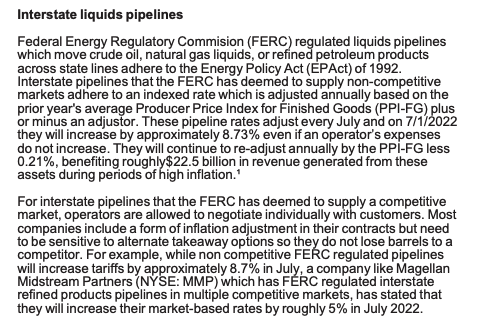
Some FERC rates are automatically-inflation adjusted.  Depending on the pipeline classification, rates are automatically adjusted every year, or inflation adjustments are written into the contract with the customer:


I could not google any information on wether the Canada Energy Regulator adjusts rates for inflation.  The company says NGTL "operates under the terms of the 2020-2024 Revenue Requirement Settlement which includes an ROE of 10.1 per cent on 40 per cent deemed common equity." (p178)  To me, this does not sound like it adjusts for inflation.

Here are some hints that it does take inflation into account:


Source: finchat.io

I could not get any details.  Not sure if they will adjust the entire tariff by the inflation rate, or only the part reflecting increasing maintenance costs (while excluding build costs from the past).  This would be a small adjustment as maintainence costs are low for gas pipelines.

So for inflation protection:
  • US pipelines adjust for inflation.  Yearly if its a "non-compeditive" pipeline.  For "compeditive" pipelines, its based on the contract, so will depend on if you have pricing power.
  • Not sure if/how Canadian pipeline tariffs adjust for inflation (?)
  • If an area has too many pipelines and not enough demand, prices will go down, regulation and inflation adjustments don't matter.

Cashflows

Dividends are lower than CFO, but CFI is very high due to capex on new projects.  CFI plus dividends has exceeded CFO in many years:


Projected capex is below.  Maintenance capex (part of CFI) is approximately ~2bn per year.  I've annotated for their later Costal GasLink blowout:


So its not until 2026 that they'll start paying down debt.

Debt

At end 2022, debt was 51bn: 41bn in loans or notes, plus 10bn in  Junior Subordinated Debt.  Thats unsustainable, at 8X 2022 CFO, or 12X 2022 FCF.  CFO should grow (probably another 3bn in the next 5 years) as the new projects come online, so that makes it a bit better.

Debt maturity (I have not broken it down into USD/CAD debt):


What is the effect of rising rates on their debt?  I went through years of annual reports - they did not make it easy - to consolidate their debt issuance.  They have:
  • 30bn fixed rate debt
  • 8bn floating rate
  • 3bn unknown
  • 10bn Junior Subordinated debt. (p195).  These are fixed rate for the first ten years,before converting to floating rate.
If all debt due by end-2027 is refinanced at 9% (The 20 year risk free Canadian rate is ~3.7%, the US one is 4.5%.  I'm using a high rate for high debt and shitty management)...then their 2022 results would have ben lower by 900m, a 20% reduction in FCF.  The same stress test for WMB and KMI give 10% and 7% reductions respectively.

The key thing for this company is no more cost blowouts till 2025, then being able to pay down debt after that.

Risks

  • Canada's carbon tax is $20/ton today, but due to increase to $170 by 2030.
  • The company has a history of operational problems: Milepost 14, Keystone pipeline leaks, Columbia gas line pressure drop. Concerned it may be a cultural issue.
  • To much debt, especially when the Junior Subordinated debt converts.
  • They may move into ESG and renewables, which have lower returns.

Valuation

At CAD 48, its trading at a 7.75% yield.  Thats paying out 75% of their 2022 FCF.

New projects coming online should increase CFO by half in 3-5 years, but they need to pay down debt.

Misc

I don't know the withholding tax rate.  Interactive Brokers usually charges me 15% for Canadian stocks, but TRP has significant operations in the US, so it may be higher.

Edit: Nov 2023: Confirmed my witholding tax is 15%

The stock plunged three weeks ago on news of the Keystone spinoff, then recovered.  It looks like capitulation, so that may be the turning point.

I have bought a 2.5% position, and would go up to 5%.  My max size for this is half that of WMB or KMI, who have less operational and financial risk.

References

Friday, July 3, 2020

US Pipeline Companies: Part #2

Williams Companies

Their business: Mostly Natural gas, they break down their segments by geographic region:
  • West: Gas gathering, processing and treating in several Western US shale oil fields.  27% of 2019 EBIDTA.
  • Northeast G&P: Gas gathering, processing and fractionalising in the Appalachians.  30% of 2019 EBIDTA.
  • Transmission and GOM: Transport along their Transco pipeline, with a little gas/oil gathering in GOM.  42% of 2019 EBIDTA.
Transco is irreplaceable - more than one fifth of US natural gas consumption flows through it.  for Northeast G&P, Morningstar estimates that Williams collects about a third of overall gas volumes across the Appalachian region.  Their other assets are more exposed to market forces, especially declining crude.

West could be badly affected by crude oil shut-ins, as 30-40% of US natural gas production is associated with crude oil (the gas is an unwanted by product).  Northeast G&P would not be affected  and may even benefit if gas prices rise due to a falls in associated gas.  Transco would likewise be unaffected or benefit.  I believe more than half of GOM's natural gas production is associated with oil wells, so they may be hit too.

Leverage: 2019 debt was 5.4 times EBIDTA.  Very high.  They aim to reduce it to 4.2 times.

For operating leverage, 2019 CFO was 40% of revenue (excluding product sales).  ie: Service revenue would have to fall by this much before they start losing cash.

Valuation: Trading at a 7% trailing yield, with CFO at 1.8 times their dividend.

Growth: Still growing.  Capex in 2018 was 4.2bn, 2019 was 2.4bn, 2020 is expected to be 1.5bn.  For comparison, 2019's CFO was 3.6bn.  They have not announced further cutbacks to 2020 capex.

Near term they have earmarked 3.2bn:


Longer term they have other opportunities:


Management recently said they expect to have "positive free cashflow" from now.  Specifically: without any asset sales, their operating cashflows should support both their capex and dividends.

Long term or political risks: Don't see any.  Natural gas is environmentally clean and has low carbon emissions.  Oh wait...all fossil fuels are bad - one of their proposed pipelines was just killed by NY.

Worst case scenario:  Again, lets say US crude production halves. I'm going to assume that all gas production in their 'West' segment is associated with oil (1) (2).  So if gas production halves, revenue halves, and the company's CFO drops by 900m or 25%, to 2.8bn.  After the projected capex, they would have to cut their 2020 dividends to ~ $1.05,


Kinder Morgan

Their business: Mostly Natural gas:
  • Natural Gas: interstate and intrastate natural gas pipeline and storage systems, gathering, NGL fractionation, and LNG liquefaction & storage.  57% of EBDA.
  • Refined Pipelines: pipelines that deliver refined product, and some crude.  Including some terminals and mixing facilities.  15% of EBDA.
  • Terminals: Terminals, and Jones-Act qualified tankers.  18% of EBDA.
  • CO2: produces, transports and sells CO2, used for crude oil production.  8% of EBDA
KMI owns the Tennessee gas pipeline, one of three large interstate pipelines supplying Eastern US natural gas.  The company says that 40% of US gas passes through its pipelines.  They would be considered irreplaceable,

CO2 would be badly affected by crude oil demand, while natural gas gathering would be affected by oil production.  Refined pipelines would be affected by covid.

Leverage: 2019 debt was 4.8 times EBIDTA.  Pretty high.

For operating leverage, 2019 CFO was 60% of revenue (excluding product sales).  ie: Service revenue would have to fall by that much before they start losing cash.

Valuation: Trading at a 7% trailing yield, with 2019 CFO at 2.2 times their 2019 dividend.  It would cover the newly raised dividend ($1.05/year) by 2 times.

Growth: Still growing.  They announced they were reducing 2020 capex from around ~3bn to 2.2bn.  For comparison, 2019's CFO was 5bn.

Their new projects before the announced reduction are here (slide 13).  The reduction was probably in CO2:


Long term or political risks: The usual ESG stuff.

Worst case scenario:  Again, lets pessimistically say US crude production halves.  And KMI gets corresponding reductions in revenue as customers go broke.

For Natural Gas, how much would be affected by the halving crude production?  They say that gathering and processing was only 10% of EBDA (slide 21):


I can't relate this to revenues, but assume it cashflows from this fall to zero, as revenue is halved.    Thats an 800m reduction in earnings/cashflows.

For CO2, its easier - halving 2019 revenue subtracts 600m from earnings/cashflows.

So total, we lose 1.4bn from cashflows, which is now 3.6bn.

This gives us enough to cover the 2.2bn capex, but not enough to cover the 2.4bn in dividends - the $1.05 dividend would have to be cut to 60c to be cashflow neutral in 2020.

Lets also say that their refined revenue halves over 2020, due to covid.  This is realistic - not pessimistic - but its only temporary.  KMI's refined revenue also halves, as refined fees are usually volume based.  That removes 900m from their Products revenue, they will still have 500m they could use for dividends, or around 20c per share.

Conclusion

I like Williams and KMI the best, as natural gas is not affected by covid, and is only partially affected by crude.

Although both have high leverage, I can't see any way either company fails.  The dividend is comfortably covered under normal conditions.  And both have growth potential.

KMI has slightly more short-term downside due to more refined exposure.

In general, these types of businesses are predictable and profitable.  Its the black swan risks to watch our for (like Deepwater Horizon).  Or the political ones (Green New Deal).

Wednesday, July 1, 2020

US Pipeline Companies: Part #1

US pipeline companies are trading at 8-10% yields.  When stocks trade at that valuation, usually it means theres something wrong with them.  But these are exceptional times.  Lets take a quick look.

All of these companies own pipelines, with most revenue from long term take-or-pay contracts that don't depend on volume.  Their revenues should hold up - unless their customers go bankrupt, which is what the market is concerned with.

I'm trying to see how badly their businesses may be affected by the plunge in crude prices.  The crude market looks terrible now, I expect US crude production to drop in a seesaw pattern for 1-2 years, then grow.

Magellan Midstream

Their business: 62% of 2019 profits are from Refined Products (pipelines from Texas/GOM, up to Wisconsin/North Dakota/Wyoming), 38% from crude (pipelines covering Permian and GOM).

Their Refined business is large enough to be irreplaceable: they provide more than 40% of refined product in 7 of the 15 states they serve, and can access nearly half of nationwide refining capacity.

Refined usage has taken a beating due to covid.  I expect it to get worse for the year - the previous outbreak hit New York, the next outbreaks will equally spread in rural/red states. Probably get a recovery in 12-18 months, as the US situation changes from lockdowns into a normal recession.  For now, refined product demand has bounced a little after falling off a cliff:

Source: Macrovoices #122 Art Brennan, slide deck

Leverage: 2019 debt was 3.1 times EBIDTA.  Pretty low.

For operating leverage, operating expenses (excluding D&A, including interest and G&A) were about half 2019 transport/terminals revenue.  ie: revenue would have to fall by half before they start bleeding cash.

Growth: Limited.  They are paying out most of their cashflows as dividends.

Valuation: Trading at a 9+ percent trailing yield, estimated payout ratio 90-100%.

Long term or political risks: Gradual decrease in fossil fuel usage, replaced with electric cars/trucks/planes.

Worst case scenario: Lets say US crude production halves, and Magellan's crude revenues (620m in 2019) halve with it (half their customers go bankrupt).  Rough guess, this removes 300m from their profits, reducing the CFO by the same amount, and dividends by 1/3rd (slide 10).   So even if you think US crude production is permanently and badly impaired - which I don't - the dividend is still 6%.

Long term, I don't see Refined dropping.  They are under long term take-or-pay contracts.  The problem is if their customers go bankrupt during the lockdown period.  I estimate lockdowns will be on/off in different states for another 18 months.

Conclusion: 
I can't see any risk to this company's long term prospects, and I think their cashflows/dividends may take a temporary hit before going back to 2019 levels.  Short term, if their dividends drop, so does the share price.  Long term, its a cyclical play where you're paid to wait.  The only downside is limited growth.


Enbridge

Their business: 2019 EBIDTA breakdown:
  • Liquids Pipelines.  A series of pipelines transferring crude through Canada to the US.  Also covers most US shale basins, handling 25% of all US crude.  Tolls on the Canadian Mainline are based on volume (pp14-15), tolls on the US interstate pipelines are long term take-or-pay.  56% of 2019 EBITDA.
  • Gas Transmission and Midstream.  Long continent-spanning pipelines transferring gas from Canada to the Vancouver/US, and from US producing fields (especially the Marcellus) to consuming states.  Take-or-pay.  25% of 2019 EBITDA.
  • Gas Distribution and Storage.  A regulated utility consisting of last mile distribution of gas to Canadian households.  Also an unregulated storage business.  13% of 2019 EBITDA.
  • Others.  7% of 2019 EBITDA.
They are heavily exposed to crude oil volume:
  • Its 56% of EBITDA.  
  • Canadian Mainline pricing is volume based, so lower volumes will be felt immediately. Morningstar estimates that Mainline accounts for 30% of EBITDA.
  • It will have new competitors: TCE's new Keystone Phase 4 is expected to be operating in 2023 (unless Trump loses) and will compete with them.  Same with the Trans Mountain pipeline.
  • Meanwhile, Canadian crude output has fallen due to low prices.  Canadian crude usually trades at a large discount to WTI, because it is landlocked, and must go to the US for refining.
  • Canada's crude production is also energy intensive (like using steam to melt bitumen), so have high fixed costs, despite unlimited reserves.
  • So I think Canadian crude producers are marginal producers.  They may do very badly during this crude crisis.
Enbridge's US interstate gas pipelines (TETCO) distributes gas from the Marcellus down to the Southern US, and is irreplaceable. It would also be unaffected by crude.

So we have 30% of EBIDTA serving marginal (ie: Canadian) producers on volume contracts, in a market crunch, with long term competition coming up.  And another 26% on the US side under take-or-pay (where we would only be worried about customer bankruptcies).  With the 38% of EBIDTA being stable.

Conclusion:
I don't see this as a dividend stock, but more cyclical, levered to WTI (actually to the WTI and WCS differential).  If I want to play an oil price recovery, its probably better to buy Enbridge's customers (CNQ & Suncor).  Right now I'm looking for steady dividend stocks.


Enterprise Products

Their business: Their business segments by 2019 Gross Operating Margin (similar to EBITDA - p83) is 49% NGLs, 25% crude, 13% Natural Gas, 13% petrochemical & refined.

What are NGLs?  Natural Gas Liquids extracted from natural gas at the wellhead.  Different NGLs have different uses, in industrial, heating and transportation:

Source: EIA

In general, the 'wetter' the gas, the more NGL's it has.  So dry gas (from the Marcellus) has less NGLs than associated gas (from shale oil):


Source: IHRDC training course: Gas Processing and Fractionation.

EPP's NLG pipeline covers most shale (oil and gas) in the west and south US:


Source: EPP System Map

EPP's NGL processing revenue is currently mostly fee based (top of p5)... ie: based on volume, with contracts lasting one to ten years.  Their NGL pipeline revenue is also volume based (p7).  Their NGL fractionation revenue is a mix of volume, and commodity prices (bottom p11).

Given these, their EPP's NGL earnings are dependent on crude prices.  First, as associated gas production falls, NGL production falls with it, affecting their volume based payments.  Second, associated gas has more NGLs than dry gas.  The effect on falling crude on NGL supply/demand is very complex.

Lets look at crude (13% of Gross Operating Margin).  Their crude pipelines cover the Permian, Eagle Ford, Haynessville and GOM, with pipes running to Cushing.


I'm guessing that most of their crude is from shale, and will decrease as prices drop.  Their crude pipeline profits are volume-based (bottom p15).  So dependent on crude oil prices.

Their Natural Gas assets (13% of Gross Operating Margin) seem to be around shale oil fields (except for GOM):

And profits are volume-based (bottom p20), so this is again dependent on crude prices.

For Petrochemical and Refined (13% of Gross Operating Margin), they do not say specifically, but I guess they are dependent on the economy.

Conclusion:
I like EPP's long term track record, but all their business segments could be exposed to falling crude production.  I can't estimate how much.  Too risky now.  I may look at them later as a cyclical play if they are hit by falling crude production.