Showing posts with label Stock exchanges. Show all posts

Friday, November 18, 2022

Bursa Malaysia (KLSE)

 Malaysia's stock exchange looks cheap based on historical earnings, lets look further.

You can't buy it with Interactive Brokers, I trade KLSE stocks with a Singapore broker.

TLDR: Everything depends on KLSE trading volume, which is unpredictable, I think this stock is too expensive now.


Malaysia is a developing country.  Its a commodity producer, and I expect commodities to do well this decade.  It also exports electronics and mid-tier microchips, so may benefit from manufacturing leaving China.

Business and Revenue Breakdown

Most of their revenue is from trading:


And most of the trading revenue is from Securities trading:

So Securities trading is the only thing we have to think about.  Derivatives trading revenue is constant, and Islamic Trading is small.  This is a company with one single business.

Financials

Good financials.  All stock exchanges seem to follow the same pattern.  As of Sep 2022:
  • Large net cash position (plus some Investment Securities), no debt
  • CFO is basically PBT plus small depreciation and small working capital.
  • 40% profit margin (after all expenses, including tax) in 9M 2022.
  • Minimal Capex with high dividends:
  • The dividends are too high:
  • They are paying part of the dividend out of accumulated "cash and investment securities".  As of 3Q22, "cash and investment securities" is worth RM 565m, or roughly 9% of their market cap (@ 6.40 per share).

Conclusion

This stock exchange is a cash generating machine.  The only question is how much you'd pay for it.

Everything depends on whether we think the big jump in Securities Trading revenue in 2020 and 2021 can be maintained.  This company is easy to understand, but hard to value.

If I had to catch a falling knife, I'd probably be willing to pay 12-15X normal earnings.  Based on 2017 to 2019 earnings, the price would need to drop significantly, to around RM 3.70 to 4.00.  Not buying it now.

Saturday, November 12, 2022

Bolsa Mexicana de Valores (Mexico Stock Exchange) : BMV

Theres a big hole in my dividend portfolio from selling my REITs.  I'm looking at several small listed stock exchanges: most of them have low debt, churn out cashflows/dividends, and their costs are not affected by inflation.  They are cyclical, so the current downturn might be a chance to buy.


First is Mexico.  It has a young, growing population, and benefits from NAFTA's (re)industrialisation.  But the Mexico stock exchange is near dead, with a matching share price.

Business and Revenue breakdown

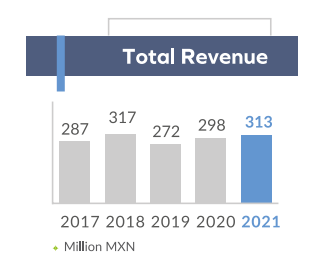
Despite its name, the Mexican stock exchange only accounts for a small amount of BMV's revenue.  I breakdown their 2021 revenue below to get an overview of their business.

SIF ICAP

16% of revenue.  SIF ICAP is an inter-dealer broker handling transactions between financial institutions.  They deal in govt/corporate bonds, and OTC derivatives (customised contracts that aren't traded on an exchange) such as interest rate swaps and forwards.

2/3rds of SIF ICAP revenue is from Chile, the remainder from Mexico.

Historical revenue:

Information Services

16% of revenue.  70% of that is from BMV market data, 30% from VALMER (Operations Valuation and market Reference, eg: used to value bonds).

Market Data historical revenue:

Valmer historical revenue:

Equities trading and clearing

13% of revenue.  From stocks traded on the BMV.  This includes foreign listings on the BMV.  eg: Apple or an S&P500 ETF, listed in Pesos.

BMV has a problem with their stock exchange.  Only 144 companies are listed, very few for the 15th largest economy in the world.  3 companies delisted this year, at least one of those wanted to re-list in the US.  One company listed this year.  The usual complaints are about low liquidity.

In 2018, a competing privately-owned stock exchange BIVA, was setup with lower listing requirements aimed at medium sized companies.  At its debut it had 52 listings, now it has 88 listings (not sure if they are all equities, or some bonds).

The value and number of BMV IPOs in recent years is below.  With only 15 listings since 2018, its growth is trailing BIVA:

Listing and Maintenance fees

13% of revenue.  In 2021, almost all of it were Maintenance fees.  This is recurring, unless companies delist.

Only 1/3rd of the maintenance is from shares. While half of it is from corporate or govt bonds:

Derivatives Trading and clearing

7% of revenue.  These are derivative products listed on an exchange.

Central Depository

33% of revenue.

A Central Depository allows every trade to be recorded, so ownership is recorded by them instead of your stockbroker.  After you make a trade,  the confirmation is sent to you independently by them.  This makes if hard for your broker to commit fraud, and theres no risk of loss if your broker goes bankrupt.  This process is slower and more expensive than just relying on your broker (like Interactive Brokers) to hold your stocks.  I do not know what percentage of individual trades go through the central depository, and what percentage go through a broker.

The Central depository records holdings from the above segments:

  • SIF ICAP (probably only Mexican, doubt it does Chile)
  • BMV.   Probably BIVA too (?)
  • and Derivatives.  

Financials

The financials seem almost too good to be true!

  • Operating margins (after all expenses, including taxes) are exceedingly high:
  • As of 3Q22, cash on balance sheet is greater than all liabilities (not just debt).
  • Cashflows follow profits closely.  Depreciation and working capital are minimal:

  • Minimal Capex:

Valuation

Reasonably priced now, not really cheap.  At MXN 36, its trading at 12-15X recent years (probably peak) earnings:


Currently at a 5% yield (before witholding tax).  The dividend payout ratio is usually around 80%:

Conclusion

Pros:
  • Excellent financials and profit margins.  
  • Mexico has long term growth potential with as NAFTA's low cost manufacturing hub.
  • Stock exchanges are a good hedge against inflation.
Risks:
  • The Mexican stock market has structural problems (low liquidity, leading to lack of investor interest, leading to lack of listings).  Note the downward trend in Maintenance fees from 2019 to 2021.  From a Mexican's point of view: if I lived next to the largest economy and stock market in the world, I'd probably want to list and trade there too.
  • Competition from BIVA.  I estimate that long term this might affect 25% of revenue ("Equities trading and clearing", plus some "Central Depository" revenue).
  • I don't know about competition or cyclicality in the SIF ICAP segment.
  • Not yet cheap, but reasonably priced.

Misc

Singapore residents pay 30% witholding tax on dividends through Interactive Brokers.

Article on VIC from 2020.