Showing posts with label LVMH. Show all posts

Monday, December 3, 2012

Prada

3rd largest luxury handbag brand/company in the world.  For fashion and leather, the Prada brand had 2011 sales of 2b Euros, compared to:
  • LV's sales of 8.7b (includes all LVMH's fashion and leather brands - Fendi, DKNY, Loewe, Celine and others - majority of sales are probably from Vuitton).
  • Gucci's 3.1b (part of PPR).

What do they do?

In 1H12, 62% of their (company wide) sales were leather goods (excluding footwear), so we'll concentrate on that.  In Asia, I would say that all the 'fashion' stuff is really just there to decorate handbag shops.

Prada bags are roughly the same price as LV, in the middle of HSBC's luxury pyramid:


I believe Prada is targeted at women over 30.  Their sister brand, Miu-miu, has bags around 30% cheaper, aimed at younger people.

Prada also owns Church and Car Shoe - they are insignificant so ignored here.

Prada is more fast-moving than LV: they are more design or fashion driven.  As a they were initially a clothing brand, they have collections and fashion shows every year.  As much as 70 percent of its products are renewed every year.  They also hold 'flash sales' of limited edition items available one-time only, and constantly add new collections (e.g.: Valentines day).  Although their signature look is "black leather with a small gold logo", they have a larger variety of bags with different shapes/colors, compared to LV or Gucci:


Although LV's bags have changed (e.g.: neverfull), their colors and logos are the same as from ten years ago.  Even their new designs (e.g.: Athena hobo) are 'logo driven'.  Every bag I see  in an LV shop had an instantly recognizable logo.  Good, because the bags are 'timeless' and instantly recognizable.  Bad, because they are becoming boring and ubiquitous.

Other than that, Prada's business model is similar to Vuitton:
  •  Opening new retail outlets:

          They intend to add 100 outlets in 2012, 60 in 2012 and 60 in 2014.

          From DBS (Mar 12), they still have less than half LV's outlet numbers.

           Still have low penetration in China and the US:


  • Reducing sales through franchise stores (down to 25 stores in July 2012):

  • Reducing mark down policy: DBS Mar 12: "Since 4Q09, Prada has cut down price reduction rate for certain products from 50% to 30% and some from 20% to 10%".
Interesting that Prada spends a lot less on marketing and advertising than LVMH (5% vs 11.5% of sales in 2011).

Made in China?

Unlike Vuitton, which manufactures its products in-house in Factories in Europe and California , Prada manufactures all over the world.  From the DBS report: "It outsources c.80% of its product manufacturing processes to  c.480 external manufacturers (semi-finished and finished products) while keeping the balance 20% of processes in-house, hence ensuring at least one important phase of the production process is performed internally. Prada has a total of 11 in-house factories (10 in Italy,  1 in England)."

About 20% of Prada's collection (including some bags) are made in China.   "Sooner or later, it will happen to everyone because [Chinese manufacturing] is so good," Prada designer Miuccia Prada said in an interview.  "What do you care where I make my shoes?" says Prada Group NV Chief Executive Patrizio Bertelli. Where local laws permit, Mr. Bertelli says he'd prefer to insert a "Made by Prada" tag in his products.

I think that Prada is doing this because, as they are more design and fashion orientated, they need faster and responsive manufacturing capabilities.  Unlike LV.  I don't know if this will become an issue: Coach and Burberry manufacture in China, but their bags range from several hundred to SGD 1.5K - almost half the price of a Prada or LV.  I believe that, for an Italian luxury brand, people do not expect their bags to be made in China.  And in Prada's price range, people do want to have to search for the hidden label to see where something is made.

Maybe people will accept it, maybe not.  This is possibly a serious threat to the image...the authenticity of the brand.

Management

Company is led by Micciu Prada (63) who handles fashion, and her husband Patrizio Bertelli (66) who handles business.  This article suggests that their children (early 20s) may not be part of the business.

This article mentions a high turnover of execs due to Bertelli's style.

An old 2001 article: Bertelli, some Prada people say, wants to go mass-market by buying brands such as Italian tennis-shoe company Superga and sticking the Prada name on everything from fragrances to jewelry. " 'We don't see ourselves as a luxury company in strict terms,' says Bertelli, who points out that people who buy Rolex watches also buy Swatches. "  Fashion or Luxury?

Could not find Prada's conference call transcripts.

The company is under family control: almost 80% of Prada SPA shares are held by PRADA Holding BV, leaving a ~20% free float.

Profit breakdown

Their largest costs are COGS, which as a proportion of sales has been dropping steadily over the years.; Probably due to the increasing proportion of retail sales:

This has givem both top and bottom line growth for the past few years.

Their expansion over the years comes at a risk of increasing operating leverage (e.g.: fixed costs from store rentals). Their operating costs are given in 2 breakdowns (footnote 35).  The main one is personnel, followed by Admin: Its not really possible to guess which are fixed costs and which are variable:


The largest costs in in the 2 different breakdowns are 'Selling' expenses and 'Staff' costs.  Fixed or variable?  I do not know if Prada sales associates earn a commission or not.  Some brands pay commission (6% given here), some don't (Vuitton).  COGS is probably variable, since most of their production is outsourced.

Liabilities

From the 1H12 results, balance sheet looks clean. Debt has steadily been shrinking since listing in 2010.  Retirement liabilities of 42m are insignificant compared to the 289m half-year's profit.

Only possible issue is the high operating lease commitments: 254m due within 1 year.  And 771m due in the next four years.  A significant fixed cost.

There one contingent liability: The Shareholders’ agreement signed between PRADA spa and Al Tayer Insignia llc for the development of a Prada and Miu Miu network in the Middle East provides that the parties may exercise an option whereby PRADA will buy back up to 20% of PRADA Middle East fzco shares.

Cashflows

CashFlows from operations has been higher than earnings every year since listing.  The difference is mostly depreciation and amortization:

Working capital is usually negative (but very small compared to the depreciation and amortization).  WC was only positive in 2009, as inventories and receivables were drawn down, probably due to recession:

CFI has been less than CFO, generating free cashflows every year:


Conclusion

Seems to be a cash cow, and growing.  In that respect, its like Richemont: a cash cow with high operating leverage, but little or no debt.

The risks are:
  1. Its a single brand only, maybe two....Prada and Miu-Miu bags are kind-of similar. More than LV or Gucci, Prada relies on constant updates to get people to buy.
  2. The "Made in China" issue.  Long term, it may threaten the desirability of the brand.  Fashion vs luxury?
  3. Has not been listed for long enough to see how demand is affected during recession.
See how they sales and profits are affected during a recession first.  If I do buy, I must remind myself to buy less, due to 1. and 2.

Thursday, June 21, 2012

The Luxury Watch Industry

Market Size

As most luxury watches are Swiss made, we take the Swiss watch sales published by FH.  These are export prices; multiply by 2.5 to 3 to get the retail values. The numbers are not broken down into segments: the total covers everything from a million dollar handcrafted luxury piece to a $35 dinosaur watch.


The hard luxury industry is highly cyclical - we have a 22% decline in 09:


2011 export sales were 19.3b Swiss francs, or 16b euros.  Multiplying by 3 for retail price, gives 48b total market size.

China

China is an important source of demand.  29.7% of 2011 Swiss Watch sales went to HK and China, however this does not account for overseas travelers:


Mainland Chinese tourists may account for 40% of all luxury sales in Europe.  This means Mainland China may account for 30-40% of the Swiss Watch market.

China represents a huge growth opportunity and a risk.  Johan Rupert (CEO of Richemont) colorfully likened it to having a black tie dinner on top of a volcano. "There is a volcano somewhere, whether it’s this year, in ten years’ time, or in twenty years’ time. We are exposed to China.  I think they are going to travel more...I think they are going to survive....we are now a ‘China play’...Personally, I don’t think anything’s going to go wrong in China. That’s my view, but I know nothing, and I mean it. I may be too optimistic about China, but if you have differing views, remember, it’s critical."


The Players

Looking at the largest players, which price segments they operate in, and guessing their market share:
  • Swatch: Multitude of watch brands, from basic watches (like the dinosaur above) to high end luxury.  Best known brand is Omega.  For FY11, (finished timepiece) sales were CHF 5.9b, or 4.9b Euros.  Did not find their percentage of retail vs wholesale sales in the annual report, nor a breakdown of basic vs luxury.  Lets assume 75/25 wholesale/retail with 50% retail margin: gives 8.5b Euros or 17% market share.
  • Rolex. A secretive private company, only in the luxury segment.  Estimated to produce 1m pieces a year, lets assume at a retail value of US 8K each, gives total Euro 6.4b a year, or 13% market share.
  • Richemont (CH:CFR). Publicly listed company controlled by the Rupert family, owing Cartier (watches and jewelery), Van de Appels (high end jewelery), and several watch brands in the Luxury and High End luxury range.  Richemont's FY11 watch revenue was 3.3b Euros, or 7% market share.  Probably higher, as 58% of the company sales (not necessarily watches) are to wholesalers.  Lets estimate 9% market share.
  • LVMH: (Tag Huer, Zenith, Bulgari, Hublot) Lists 1.9b Euros revenue for watches and Jewelery (not broken down).  If 70% of these sales are watches, that gives 4% market share.
  • Independents: People who set up their own watch company, e.g.: Frank Muller
As I don't have the numbers, these are really rough estimates...guesses upon guesses.  Would be better to break down into different segments, as basic watches and high-end luxury items are different markets, not competing substitutes.  Except for Swatch, all these players only deal in the luxury market, and Rolex is probably the leader there


ETA Watch Movements

An estimated 2/3 rd of all Swiss made watches use movements from the Swatch group (for example).  As a near-monopoly under anti-trust regulations, it was required to provide to other companies both watch movements (to put them in a watch case and sell) or mechanical ébauches (allowing the buyer to modify the watch movement before assembly).  Swatch objected, and in 2004 was told it could stop selling ébauches after a transition period till 2008.  Swatch announced in 2009 that they would also reduce the supply of completed movements, though this has since been delayed to start in 2013.

Few alternatives Swiss companies could pick up the slack, main one is Selitta.

A harder issue is assortments (e.g.: hairsprings).  Swatch's Nivarox is the only major Swiss supplier, and they are reducing assortments by 5% in 2012.


How do the different players handle this?

Barriers to Entry

There are two main barriers to entry:

First, time and money to build the capacity to produce watch movements and assortments:

“If we have to make assortments one day, we’ll make assortments. Obviously it’s difficult. It will take money. If we have to spend $20 million or $30 million to manufacture hairsprings, we can do it. It will take time. Initially they will cost much more than Nivarox hairsprings because only 50 percent will be good. We will have to go through all the hurdles.”

Second, time and money to start a brand.  Takes years of plastering your advertisements everywhere, as well as getting celebrities to endorse (or better still, to wear because they really like it), and generating buzz to build a brand which is recognizable to 'normal' people (not just watch lovers).


 How do companies enter this business?  Some examples:

  • Franck Muller: Started designing/producing individual pieces for private clients in the 80s.  Built a tourbillon watch back when few others were able to do so; dubbed 'Master of Complications'.  House of Franck Muller started in 1993, famous for curvex shaped watch and for putting colorful numbers on the face.  Some watches use ETA movements.  Currently produces 40000 pieces a year.
  • Azimuth: Started in 2003 in Singapore, with attention-catching designs (spaceship watch, robot watch).  Very niche.  As of 2009: produce around 1500 pieces a year with selling from SGD 2.5 to 7K.  Most of their watches appear to be modified ETA movements.
  • Nomos Glashutte: started in 1990, Germany.  Watches have classical, bauhaus style design.  First watches used ETA movements, after 2005 they start to manufacture (some or all models?) fully in-house.  Very little marketing: may advertise in German watch magazines, and managed to get articles in Forbes and The Atlantic TimesFew authorized dealers, most sales done online.  Watches cost from 1000 to 5000 Euros.  Don't know their annual production.

From these examples, it seems that either you start at the very high end like Frank Muller, with limited production for individual clients, or at the low end (that is, low end for luxury goods).  Both these sidestep the advertising costs.   At the low end, they all started off using ETA movements: seem to rely on eye catching design for watch-lovers to discover their offerings (probably online).  Azimuth and Nomos are at that stage now - sort of flying 'under the radar', serving a niche market.  Frank Muller has somehow managed to move into the mainstream, where the brand is now recognizable by normal people.

Swatch's restriction on movements and assortments, as well as proposed tougher 'Swiss Made' labeling regulations may make it harder to start a new brand from scratch in the future.

Morningstar gives both Swatch and Richemont a narrow economic moat.  I agree - although hard, its possible for a brand new company to start up and go mainstream within 20 years.


Friday, June 15, 2012

Luxury Watches for Beginners

The watch industry is confusing to newcomers.  So many big words, countless brands to choose from...and why do some pieces sell for 2K and others sell for 20K? 

When you buy a watch, what do you look for? And what are you paying for?  Also useful for when I look at listed watch companies later.


Price Segments

See this link for the different price segments.

Scarcity is the main thing determining which segment a brand is in.  For example, the high end luxury brand "A Lange and Sohne" produces 5K pieces annually.  A more popular luxury brand like Rolex is estimated to produce 750K to 1m pieces annually.


Brands

The highest luxury brands are only recognized by people 'in-the-know', they mostly have unpronounceable European names - A Lange and Sohne, Vacheron Constantin, Jaeger LeCoultre.... Only the more popular(ist) luxury brands such as Rolex, Cartier, IWC are plastered all over the place.  As my wife said, whats the point of spending thousands of dollars on a watch if no one knows what it is?

Different brands give different images: e.g.: sporty, elegant, technically sophisticated.  You must decide how you want to present yourself to the world: Do you want to be James Bond, Tiger Woods, or some 5th generation European aristocrat speaking in ze funny accent?

Some brands maintain a basic style which is instantly recognizable among all models of that brand (e.g.: the numbers on a Frank Muller or Cartier watch).  Other brands are have no distinguishing characteristics in their lines (e.g.: Omega).

How is a good brand made?  After deciding on the price segment and image, its a long, slow process...5 to 10 years...of stoking demand, creating excitement, always producing slightly less than desired, and raising prices.  The company needs to make sure the goods are never 'on-sale', either by owning their retail outlets, or buying back unsellable goods from retailers to keep them off the grey market.

Origin

Most luxury watches are Swiss made, meaning the at least 50% their components (by value) are from there.  This may increase to 60 or 80% later.

A few luxury watches are German.  There may be some Japanese luxury watches, not sure if they can sell outside of Japan.  I think its possible for the industry to move production to other European countries...maybe even Japan...but they can't produce elsewhere and still maintain their class.


Technical

Hand wound, automatic, or quartz: this short video explains.  Quartz is a no-no for men, but OK for women.

In-House or ETA: 80% of the watch industry 'movements' are manufactured by ETA (owned by Swatch group).  Many watches, even for well known brands, simply design a case, put the movement i, and sell it as their own.  Watch enthusiasts prefer 'in-house' movements, where the company creates all parts of the watch by themselves.  You may pay $5000 for a watch which just has a movement slapped inside a case, when the same thing is available under another brand for $500.  Again it has to do with being exclusive.  A Honda is just as good as  a BMW...but, if you pay a BMW price for a Honda, you are being ripped off - and you have more money than taste...So if you have watch collectors for friends, take note.  (Again, it doesn't seem to matter for women.)


More Complications

Every second watch advert I see has a 'tourbillon'.  Here is an interesting 2007 interview by Frank Muller, I like his examples of how changes to the watchmaking industry affect the value of the end product:

"You are buying more of the dream, the image and the magic and less of the technicity. Indeed the technicity serves to primarily to support the reputation of the brand." (...my wife was right).

 "A tourbillon is a dream. It is magic.  Because it is a dream it must be a bit inaccessible....But you make the tourbillon suddenly very accessible, do some degree you destroy the dream and you break the magic."

"A real hand made rattrapante costs minimum 50 thousand Swiss Francs and suddenly you’ve got a guy who has one on his wrist that costs less than 10 thousand Francs. How will that make you feel...? Once the dream has been broken you cannot repair it and this should be the greatest cautionary tale to what is going on with the tourbillon."

In the end, it doesn't matter what a 'tourbillon' or 'rattrapante' is... or even how to pronounce all these big words - the only important thing is that prices are falling.  All these fancy complications in a watch can become obsolete.  The brand is more important, it has a better chance of lasting.


A Nice Watch

Long time ago I went to a used watch shop with my wife.  There was row upon row of watches, each one priced from 4K onwards.  Couldn't believe how fugly most were: garish colors, 4 or 5 separate dials cluttering the watch face, studded with diamonds...like something a drunk rapper would wear.

After spending all this time online looking at watches, I've only came across one that strikes me as beautiful.  It looks like a watch, is easy to read, fits nicely with casual or formal wear, and comes without the marketing baggage: you don't have be James Bond or Tiger Woods to wear it:


Probably won't get it though, 5K is too much for a watch. [edit: was only SGD 3K.  A reasonable amount, but no so much that I should have spent on stocks instead...].

Friday, November 25, 2011

LVMH

Worlds largest luxury goods seller. 2010 revenue/profit breakdown:
  • Fashion & leather goods (38%/62%)
  • Wine & Spirits (16%/22%)
  • Perfume + cosmetics (15%/8%)
  • retailing (27%/5%)
  • watches + jewelry (4%/3%)

First we look at the first 2 segments separately.

Leather and Fashion

I never imagined that I would ever, in my entire life, see a line of people queuing to shop for thousand dollar handbags.

It is difficult to convey how luxury goods are a part of everyday life here. The car you drive, the watch or clothes you wear, do really mean something. Women can instinctively identify a myriad of branded handbags, jewelery and watches at a glance.


The book "The Cult of the Luxury Brand", believes that Asian countries follow a model in their adoption of Luxury goods; the final stage is where Japan is now, where it is a 'way of life'. They write about the ubiquitous LV in Japan: "It is well past the stage of a trend, it has become an enduring requirement - like sushi or green tea - essential to the Japanese way of life...the company has taken the trend to conform to its logical end: To be Japanese means to have a Louis Vuitton bag. The brown bag with the original monogram pattern and pale leather trimmings has come to define the Japanese national identity."

In short, luxury goods are not a luxury. They are a part of everyday life. From junior office ladies to tai-tais, many people here must have them to function in society. This bodes well for the continuing consumption of luxury goods, which can be supercharged by an emerging China and India.

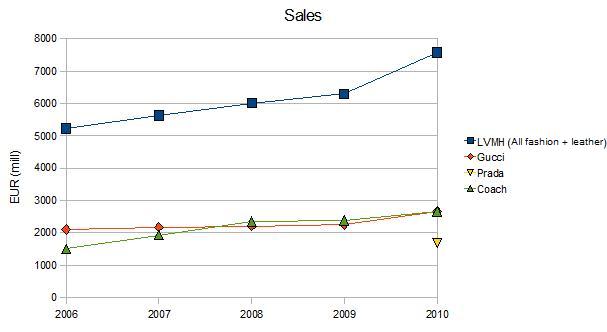
Comparing sales and profit margins of other brands with LVMH is hard, because LVMH does not break down sales for the many brands they own (LV, Fendi, Donna Karan, Loewe, Marc Jacobs, Celine, Kenzo, Giovenchy, Thomas Pink, Pucci, Belutti, Rossimoda). The chart below show show the total amounts for 'fashion and leather' for LVMH, compared with individual brands for other companies (so not really an apples-to-apples comparison):

From the above, their flagship LV brand, has, at most, twice the sales of the nearest competitor.

[For Coach, converted to Euros at a rate of 1 USD = 0.7394 Eur]

LVMH's margins are among the highest in the industry, only occasionally surpassed only by coach. The LV brand itself would probably have even higher margins, as they are lumping in all brands together.

LVMH's 'leather and fashion' revenue did not fall during the 2008 crisis. It may have been due to China, LV did not break down the figures.

Wine & Spirits

2010 revenue and profits are split evenly between "Wine/Champagne" and Spirits.

The champagne market is highly fragmented, with many producers. This article (free here) puts MH at an 18% global market share. It also discusses how MH is trying to tie up supplies in the (govt mandated) champagne growing regions. I would put MH as the largest player in a fragmented field, but with no real dominance or pricing power.

The champagne/wine market is highly cyclical, as with any commodity that has a fluctuating price and takes time to grow. e.g.: champagne grape glut in 2009, wine grapes in 2003.

For spirits:
  • MH trails the largest playes in the spirits market (2010 revenue: 3.3 bn Euros). The largest player is Diaego (revenue: 15 bn Euro) and Pernod-Ricard (June 09 revenue: 7 bn Euros).
  • MH's products do not appear in the top lists for spirits.
  • HM has a 44% share of the cognac market. Cognac went out of fashion in the early 90's, but is now revived due to rappers and China.

HM is not a leader in this market. The Champagne market is highly cyclical. And the spirits market is subject to changing fads and fashions.

Business Model and Risks

For the company as a whole, about 10% of their revenue is spent on advertising.

In the luxury goods business, the main aim is to develop a 'buzz'. Usually done by having celebrities and A-list people wear your products, appear at your parties, etc. This creates a fashion, which people talk about and want to imitate. This 'buzz' is the heart of the luxury goods business - it feeds it and is fed by it. I'm not sure exactly what creates it, but its more than throwing millions of dollars at advertising.

LVMH's income statement is quite sketchy: cannot tell how much of their costs are variable and how much are fixed. The financial statements are short: LV does not even break up their sales/margins by brand; contrast to Coach for example, which provides same store sales.

The chairman, Bernard Arnault, owns 47% of the company and has direct control. Two of his five children currently work there: Antoine Arnault has a management role and is on the board of directors, Delphine Arnault is a director, and nephew Harry Seaman may be involved as well.

LVMH owns many unrelated businesses. Ranging from a stake in Hermes (designer bags costing 50K), to cosmetics retailer Sephora (similar to 'Watsons', but for cosmetics), to Charles & Keith ($30-$40 women's shoes). Does not seem to have any focus. Combined with their sketchy financial information, makes it hard to track.

To conclude:
  • LVMH's main business is Fashion and Leather goods. The others are just sidelines or distractions. And are in more competitive markets, so unlikely to make the same margins as leather goods.
  • This is the only area they have have a competitive advantage in. The LV brand probably sells twice as much as its closest rival, and has the industry's highest operating margins.
  • This market has the potential to boom, thanks to China/India.

I'm not sure if I'd be comfortable buying this stock.